
Garry Oak
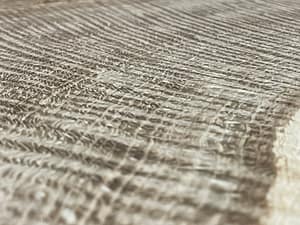
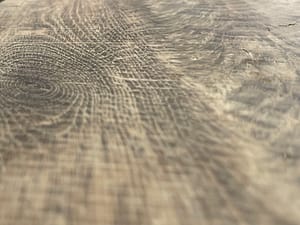
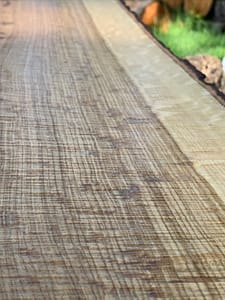
Garry Oak is Washington’s only native oak, and it grows across a shrinking range of prairie and savanna habitat in the Puget Sound region – Lakewood is one such oak savanna. A single log may carry over a century of growth recorded in dense, tightly packed grain, which gives finished pieces exceptional strength and beauty. It’s Matt’s favorite!
As Garry Oak stands are protected and increasingly rare, most of what falls comes down through storm damage, disease, or necessary removal rather than harvest. When Ranger Tree Experts brings us a Garry Oak log, we treat it as a limited and irreplicable material. We diligently continue to refine our kiln drying protocol – a process we consider a part of our purposeful stewardship of this incredible resource.
An item crafted from our local Garry Oak stands as a record of one of the region’s most storied trees, kept intact instead of burned.
Big Leaf Maple
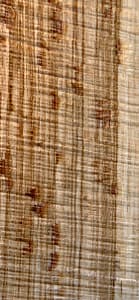
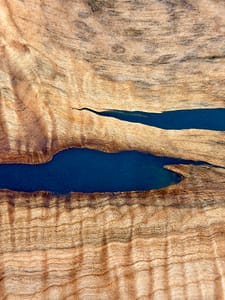
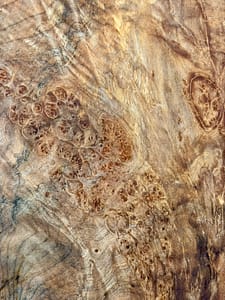
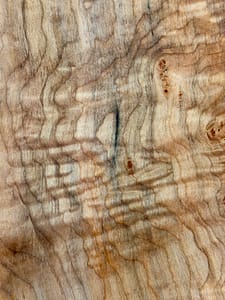
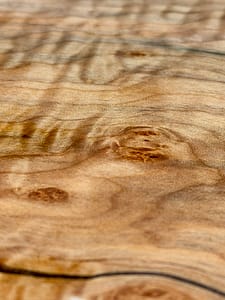
Big Leaf Maple is the workhorse of the Pacific Northwest hardwoods and one of the most surprising. This species is responsible for some of the most dramatic figure in North American wood species as a whole: curly, quilted, and spalted patterns emerge as a natural growth response to stress and fungal activity. It’s Micah’s favorite!
We maintain a significant kiln-dried inventory of Big Leaf Maple at any given time, sourced directly through Ranger Tree Experts from trees removed across the South Sound. We continue to be staggered by how wildly diverse the patterning and colors differ from tree to tree -- tightly packed curl, wild chatoyancy, creams, blues, greens, yellows – no slab is understated or boring!
Big Leaf Maple proves that one of the most common trees in our region can still produce the most uncommonly beautiful material.
Pacific Yew
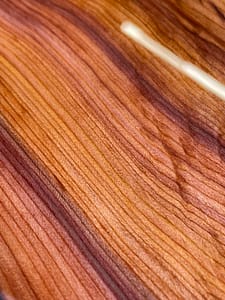
Pacific Yew is a slow-growing, dense-wooded conifer once so undervalued that entire stands were burned as slash during old-growth logging operations, before the tree's importance to both woodworkers and medicine was understood. Its heartwood ranges from a rich orange to deep purpley brown, with a tight, oily grain which finishes to a glass-like surface.
Some of the most striking Pacific Yew we encounter carries a history written directly into the wood. Logs from trees that grew for decades near old fence lines or structures often absorbed nails and metal fragments. Over time, an iron-tannin reaction stains the surrounding grain into a deep, dramatic purple, forever capturing the history of an interaction between the tree and one of our neighbors.
Every Pacific Yew piece we produce is one of a kind, both because the species is uncommon in usable dimension, and because no two staining patterns repeat. This is not a wood which can be restocked in quantity; such, we treat every piece as something special, and strive to preserve and showcase its unique natural character.
Costal Redwood
Though Redwood is not native to Western Washington, over the years local residents planted these mighty fast-growing trees in their yards and properties, and thus the trees have lived their entire lives as part of our landscape. When once comes down, we treat it the same as any other local tree: material too good to burn or chip.
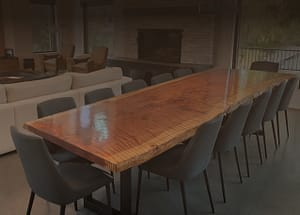
Much of the Redwood currently moving through our shop is from the very tree which started Lakewood Live Edge. Slabs from this specific Redwood tree are wildly curly, with a rippling, three-dimensional figure which catches the light differently from every angle. This kind of figure is not something we can create – it is the result of the trees' natural response to stresses accumulated while growing over decades. Combined with Redwood’s naturally rich red-brown tone and light weight relative to its size, this material produces jaw-dropping tabletops and island toppers few other species can match.
Non-figured Redwood is an excellent choice for outdoor applications as it is highly resistant to rot and decay, which makes it well-suited for environments that experience frequent moisture exposure like here in the PNW. It is a fantastic choice for benches, planter boxes, and outdoor decor.
Douglas Fir
Douglas Fir is the tree most people picture when they think of a Pacific Northwest forest, and for good reason. It is the region's dominant timber species, prized for over a century for its strength, straight grain, and reliability under load. What is less well known is how beautiful that same structural wood can be when it is finished rather than framed.
The growth rings that make Douglas Fir such a strong building material also produce a bold, high-contrast grain pattern once the wood is surfaced and finished, alternating bands of warm amber earlywood and darker, denser latewood. Old, slow-grown Douglas Fir in particular carries tight, closely spaced rings that read almost like topography across a tabletop.
Most Douglas Fir removed in this region is graded for lumber or left as slash. We select logs with strong grain character and knots, then mill them for furniture instead, thereby giving a tree usually associated with 2x4’s a second life as a dining table, bench, topographic CNC-carved Ranier, or a mantle with real presence.